Sunday, August 26, 2012

Patching a Quilt

You never know when you select a fabric for a quilt if that fabric will 'behave well'. Even if you take all the actions you need to make sure the construction is good, there are some fabrics that just don't hold up as well as the others around it.

Click on photos for a closer look.


This is the case with this quilt.  Re-sewing the seams together on the top side would make the fabrics uneven and drawn. The yellow bordering strips are coming apart at the seams in places. Since it wasn't heavily quilted in the first place, patching it is easy.

So I searched in my reserve pieces and found a yard of this wonderful ikat. The colors all relate to the colors in the quilt. How lucky can you get.

So, in my spare time, (what is that?) I have been cutting custom squares and laying them over the loose seams covering the whole area.

I'm amazed at how the new sections seem to disappear and blend in. This is a 'reckless' quilt, so the new areas fit right in.

Thursday, August 16, 2012

Pear Pincushions

Once, I got a bunch of velvet sample pieces. They were too small to do much with them, but I kept them in a box with some other pieces of fabric.


I also had some scraps of felt and a bag of pure, white sand.

So I made pear pin cushions.

I didn't have a pattern. I just decided how big I wanted them and made a pattern of my own from a piece of paper.

The size of the pin cushions are about the size of a real pear. Except when I drew the pattern, I made the top elongated so that it would form a funnel for the sand.


I sewed the pieces up on the sewing machine, clipped the curves slightly.

I filled the pears with the white sand. I had to pound them on the table top to pack the sand in tightly. I wanted the pear to be jam-packed and really full.

I made the stems out of felt cut in a square with a leaf on top at one end. I rolled the square tightly to make the stem and hand-sewed it down.


I cut another leaf or two to be added to the stem. 


I held the stem in place while I pleated the tops of the pears, folded the fabric over and tucked it in to look like the top of a pear. Then I gathered it around the stem and sewed it all down tightly.


I really like having the sand inside the pincushion because it makes them stand up well and the sand polishes the pins every time they are pushed in and taken out.

Friday, August 10, 2012

The Indigo Top

On a trip to Japan, I visited a museum about the production of indigo dye. We were able to try out dyeing our own small piece of fabric and to visit the display of antique pieces used in clothing and the home.

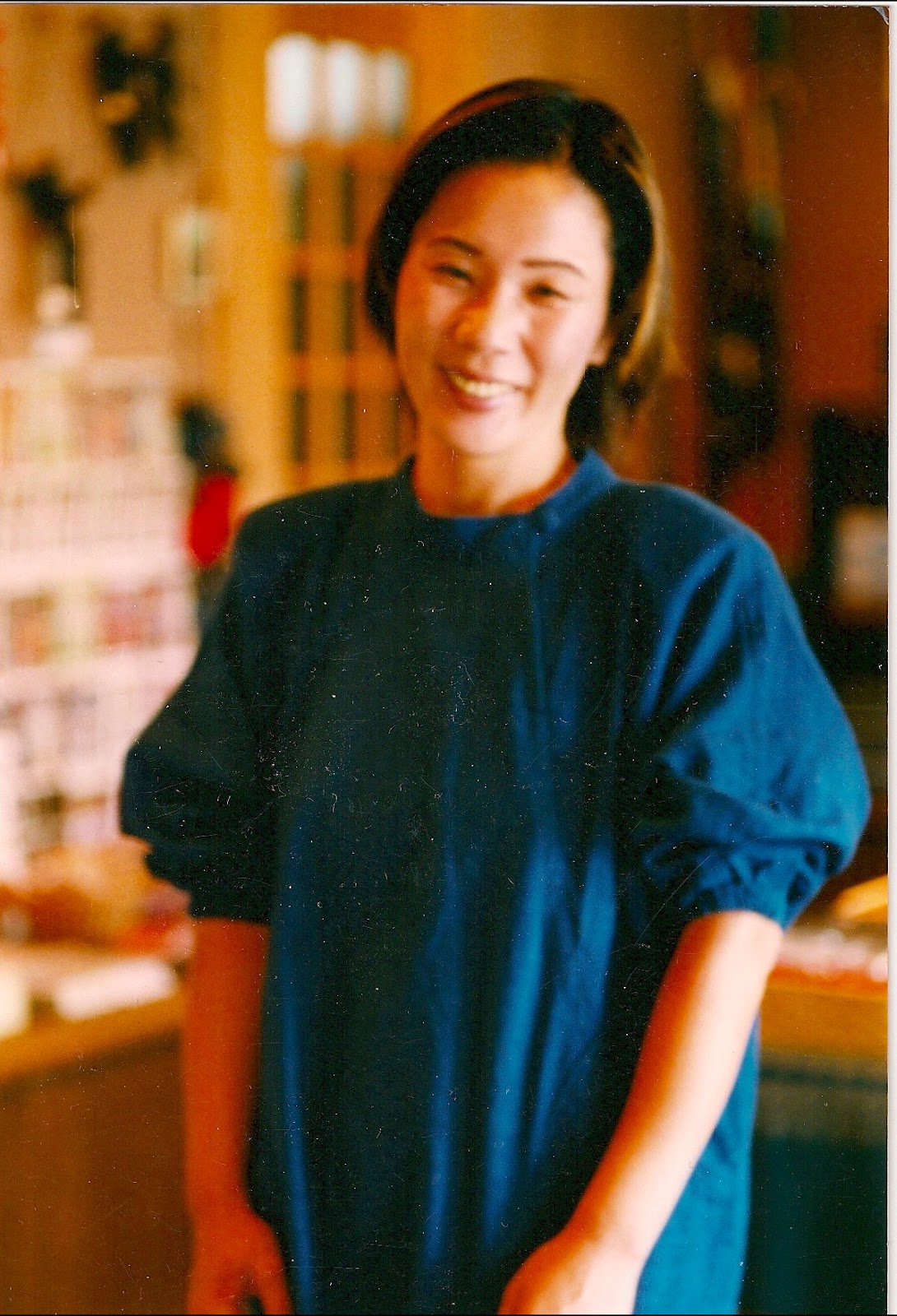
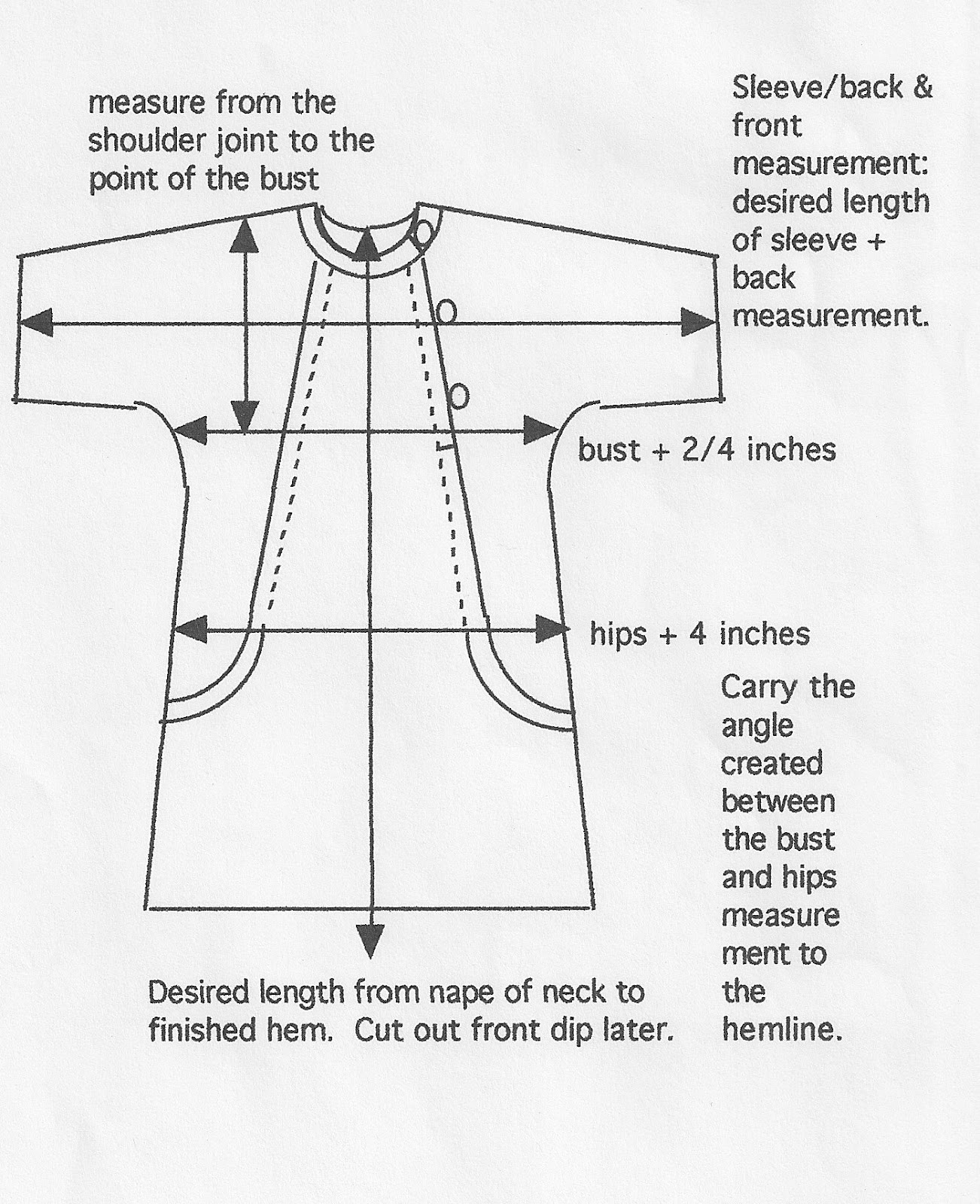
Beside the display and the experience of trying out the dye, I noticed that the guide had on a most interesting shirt.  It was a  beautiful indigo cotton with an unusual pattern. I asked if I could photograph her.  Much later, I used the photo to analyze it and draw a pattern:


This pattern was drawn using a simple little computer program called Super Paint. Too bad it is outdated now. It was great for making black and white drawings. 

Saturday, July 28, 2012

Pincushions


I love pin cushions.
Here are three really neat ones......


The green heart is one I made using my shisha skills.


The second one (which seems to have cast off it's pompom, is one I bought somewhere.
I think it's a Hmong piece.


And the third one, I picked up somewhere.  
It looks like an Icelandic or Saami people shoe. 

I was thinking about putting it on a chatelaine, but it's just too cute to use. 

Tuesday, May 1, 2012

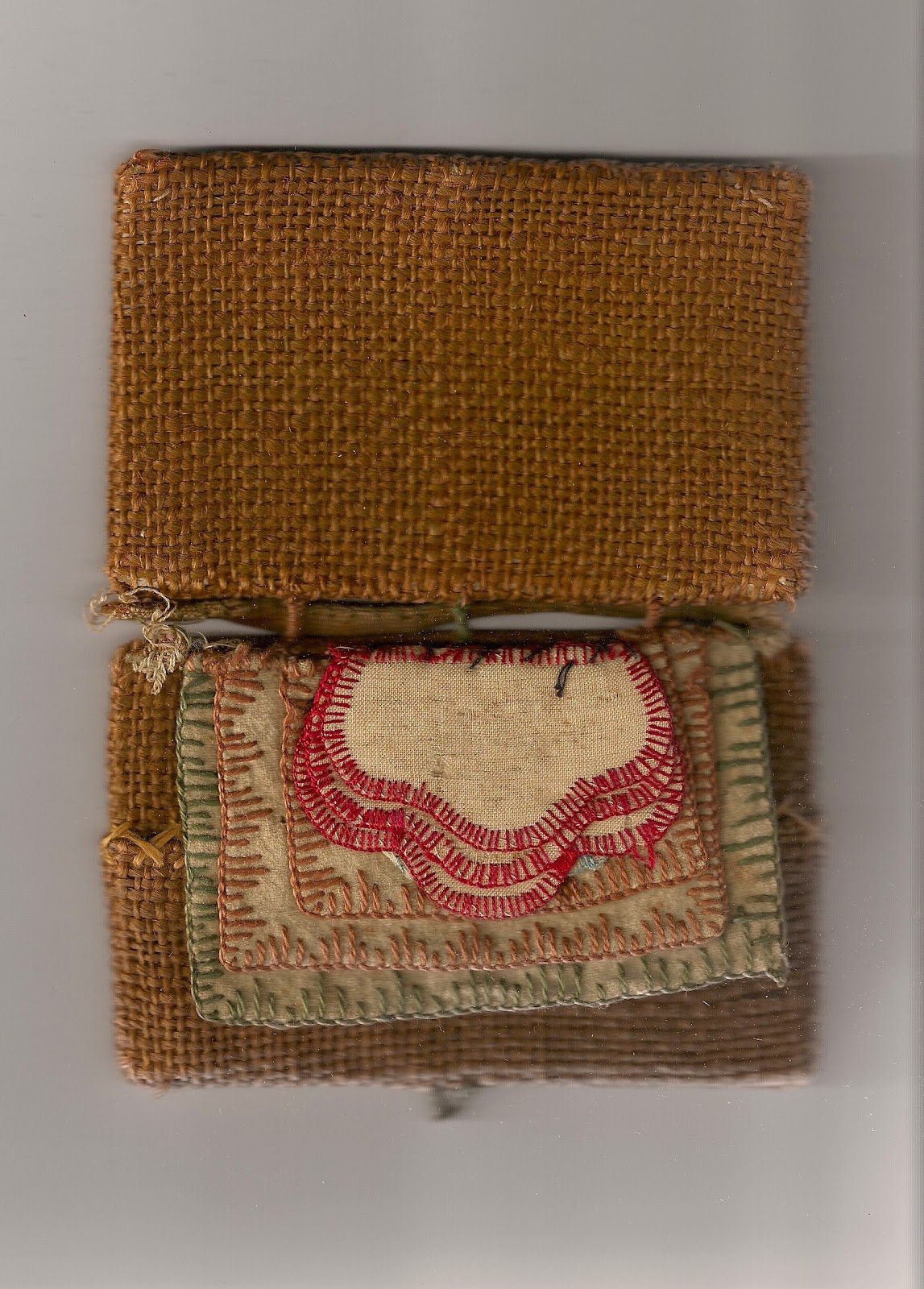
While digging in some boxes of family stuff stored away, I came across this little needle case.

I wish I knew who in my husband's family made it. It could have been the Swedish grandmother, the German needlewoman, the English great-grandmother or someone further back in time. I know it had to have been a few generations back judging from the outer fabric.

And on examining it further, I decided it was made not by a mature woman, but a child.

I would love to know what the inside stiffening material is. I have a feeling it is not cardboard but very thin wood.

Too bad the fastening button is gone; that would have been a big clue. It was very small whatever it was.

The needle case is only about 2 inches by 4 inches. And the strap on the spine is a unique feature--as if it was pinned to an apron or a dress. Maybe it hung from a chatelaine.


Can anyone tell me about the fabric?  I'm sure it was much brighter when new. The rusty brown weave is overshot and still has a shine. Silk, maybe?

Wednesday, February 1, 2012

Delightful Design


I just stumbled upon this delightful little sewing kit shown at http://lovelypackage.com/category/student-work/

More detail about the inside is available there.

I love looking at little hand-made kits and carriers.


(I've been dealing with lost files and a computer hissie fit--It's, not mine, at first. Which, of course, brought on MY hissie fit. You get the picture.

Slogging on----
Jeanette

Friday, November 11, 2011

The Befores and Afters

The kitchen is nearly finished.

Even though nothing was changed in regard to expanding walls and the enclosure of a porch to make a pantry, the whole room seems twice as large. Moving and enlarging one window, the addition of a glass paneled door and opening up the ceiling changed everything.

The only thing left to add is a movable kitchen island. I'm ping-ponging between a wooden cart type one and an industrial-look stainless steel.

So, you've already seen the business end of the kitchen--the working area was shifted away from the front and side view area. The previous work plan had me running up and down the long cabinet line. The new work area is now a rather tight triangle from the sink to the stove to the refrigerator at the back of the room.

The new pantry is around the corner where the refrigerator is now located.


The window over the sink was shifted a couple of feet toward the view and is a bit larger than the old one.

The old overhead cabinet and Norwegian "cooler" were done away with and a new door with a very large glass panel opens up the view down the shoreline.

The old kitchen had old strip light cans and another light fixture at the stove. New recessed LED light cans were installed in the ceiling and under the counter LEDs light up the work areas.


The cabinets are lacquer finish ivory white, the countertops and backsplash are soapstone. All the outlets over the cabinets are framed in black so they seem to disappear into the stone.

The old view to the east and the new one with the shortened cabinet and new door. We also placed a smaller table with some English elm chairs at the window.


There was not question that I wanted a solid surface behind the stove and work areas. None of that fiddly postage stamp tile for me! What are they thinking? Imagine what a cleaning nightmare they must be. I hope that fad dies a fast and hideous death!


Besides, when you buy stone, you get it by the slab, so why not use it all? (More about stone countertops in a later post.)

We relocated and widened the narrow doorway. So, even though the kitchen is still a separate room, it seems to link with the living room better.

The wider doorway has brightened and opened up that end of the living room as well as the kitchen.

The old cabinets were replaced with two tall Restoration Hardware French door cabinets. They are oak and have wonderful hardware.

They hold as much or more than the old cabinets. The cabinets were 1 3/4 inches too tall, so the wonderful carpenters trimmed up the bases and they just fit under the curve of the ceiling.

Both cabinets are fastened to the wall and added quarter round anchoring strips finish the bases off nicely. I mixed up some acrylic paint and matched the cabinet finish adding a thin black line between the wood and the flooring.